- Home
- Services
- Cardiovascular Services
- Cardiac Imaging Services
Cardiac Imaging Services
- Speech-Language Development
- Conditions We Treat
- Vascular Anomalies Team
- Vascular Anomalies Resources
- General Information
- Our CBIT Team
- In The Media
- Additional Resources
- Adult CBIT Program
- Heart Transplant Team
- Kidney Transplant Team
- Liver Transplant: When to Refer?
- Liver Transplant Team
- Liver Transplant Outcomes
- Liver Transplant Transition to Adult Care
- Liver Transplant Resources
- Rett Syndrome
- Our Epilepsy Team
- Diagnosis Tools
- Plan Your Visit
- Additional Resources
- Healthcare Professionals
- Treatment Options
- Our Children
- E-NEWS Articles for Epilepsy
- Brachial Plexus Injury
- Deep Brain Stimulation and Responsive Neurostimulator (RNS) Therapy
- Minor Head Injury and Concussion
- Pediatric Neuropsychology Service
- Brain Tumors
- Chiari Malformation
- Pediatric Craniofacial Surgery
- Pediatric Epilepsy Surgery
- Pediatric Hydrocephalus
- Pediatric Spine Surgery
- Spasticity Surgery and Treatment
- Spina Bifida Treatment
- Traumatic Brain Injury
- Vascular Disorders
- Specialty Clinic Contact Information
- Our Team
- Sleep Studies
- Directions
- Additional Resources
- Healthcare Professionals
- UAB Pediatric Pulmonary Division
- AYA Program
- Pediatric Blood Disorders
- Pediatric Cancers (Childhood and Young Adult Cancer)
- Pediatric Neuro-Oncology
- Pediatric Blood and Marrow Transplantation Program
- Hope and Cope Psychosocial Educational Program
- Childhood Cancer Survivorship Program
- Pediatric Neuropsychology Program
- Plan Your Visit
- Directions to our Clinic
- Oncology and Sickle Cell Emergencies
- Hemophilia and Bleeding Disorders Emergencies
- For Patients and Families - Inpatient Services at Russell and McWane
- For Patients and Families - Outpatient Services at Lowder and McWane
- Family Clinic
- PIRC Annual Report
- PIRC Helpful Resources
- PIRC-Psychiatric Emergencies
- PIRC-What to Expect in the Emergency Room
- PHP Handbook
- Meet Our Partners
- PATHS FAQs
- PATHS Team
- PICU Team Approach
- Glossary of Commonly Used Terms in the PICU
- Adolescent and Young Adult Diabetes Clinic
- Endocrine Cancer Survivorship Clinic
- Prader-Willi Syndrome Clinic
- Prediabetes Clinic
- Diabetes Center
- Lipid Clinic
- Metabolic Bone Clinic
- Newborn Screening Program
- Polycystic Ovarian Syndrome Clinic
- Turner Syndrome Clinic
- Thyroid Nodule and Thyroid Cancer Clinic
- Cortisol Replacement Therapy
- Growth Hormone Testing
- Thyroid Ablation Instructions
- Aerodigestive Care Coordination
- Aerodigestive Team
- Aerodigestive Program Referrals
- Gastroenterology, Hepatology and Nutrition
- Pediatric ENT Associates
- CCAIR Team
- CCAIR Research and Data
- Family Resources
- KidneyWell Program
- Neonatal and Infant Course for Kidney Support (NICKS)
- Our Team
- Research
- Patient Stories
- PICAN in the Media
- Patient Care Nurse
- Advanced Practice Nurse
- Research Nurse
- Bedside Nursing Instructor
- Bedside Nursing Instructor that is a COA Employee
- Partner Nursing Instructor
- Residency Nursing Instructor
- Preceptor Nursing Instructor
- Metabolic Bone Clinic
- Preoperative Education (Video)
- Scoliosis/Kyphosis Brace Care
- Spica Cast Care
- Spasticity / Botulinum Toxin (Botox)
- Cast Care
- Providers
- Cardiology Spiritual Care
- Cardiovascular Leadership
- Cardiovascular Child Life
- Cardiovascular Nurses and Support Staff
- Cardiovascular Operating Room (CVOR) Staff
- Cardiovascular Perioperative Staff
- Clinical Pharmacists
- Lactation Consultant
- Palliative and Supportive Care
- Pediatric Cardiac Sonographer
- Pediatric Cardiology Psychological Services
- Perfusion and Cardiovascular ECMO
- Physical Therapy/Occupational Therapy
- Registered Dietitian
- Respiratory Therapists
- Social Workers
- Speech-Language Pathologist
- Teacher
- Cardiac Imaging Services
- Cardiac Anesthesia
- Cardiac Catheterization Lab
- Electrophysiology
- Perfusion and Cardiovascular ECMO
- Cardiovascular Intensive Care Unit (CVICU)
- Cardiac Care Unit (CCU)
- Cardiology Clinic
- Connective Tissue Disorders and Marfan
- Orthostatic Intolerance and Postural Orthostatic Tachycardia Syndrome (POTS) Clinic
- UAB Adult Congenital Heart Disease
- Maps and Directions
- Preparing for Surgery or Procedure
- Visitation Policy
- KidsHealth Resource
- WIRED Together Camp
- Our Team
- Nasoalveolar Molding (NAM)
- Feeding and Nutrition
- Bone scan
- DMSA-Renal
- MAG 3 Renal
- Gastric Emptying
- HIDA
- Meckels Diverticulum
- Nuclear VCUG
- Thyroid Ablation Instructions
- Thyroid Uptake and Imaging
- I-123 MIBG Imaging
- Online Patient Questionnaire
- Anesthesia Pre-Admit Screening Service (APASS) - Plan Your Visit
- Anesthesiology
- A Trip to Surgery
- Online Patient Questionnaire
- General Anesthesia Imaging-Healthcare Professionals/Providers
- Online Patient Questionnaire
- Anesthesia Forms and Policies
- Surgical Services Lunch and Learn
- APASS Forms and Policies
- Children's South Forms and Policies
- Dental Forms and Policies
- One Day Surgery/PACU Forms and Policies
- Radiology Forms and Policies
- Scheduling Forms and Policies
- Brain and Spinal Cord Anatomy
- Bicycle Safety
- Age Related Injuries
- Best Practices
- Children With Special Needs
- Quick Tips
- National Resources
- 2025 URKeys2Drv Event Photos
- Safe Teen Driving Toolkit
- Teen Driving Educational Videos
- Healthy Eating Tips
- 25 Healthy Snacks for Kids
- Smart Snacking for Adults and Teens
- Additional Nutrition Resources
- Inpatient Services
- Outpatient Services
- Outpatient Forms
- For Children and Parents
- Healthcare Professionals
- Links for Specialty Food Resources
- Steering Committee
- Rotary District 6860
- Live ACE Opportunity
- Grand Rounds Schedule
- ACE Extras
- ACE Contact and Live Stream Assistance
- ACE Committee
- Planner and Content Reviewers Disclosure Information
- Statement of Purpose and Mission
- About the Residency Training Site
- About Birmingham
- Residency Rotations
- Residency Program Preceptors
- Our Current Residents
- Past Residents
- Resident Benefits
- Residency Related Policies
- Application Information
![]() |
At Children’s of Alabama, we offer advanced heart imaging to help diagnose and care for congenital heart disease in patients of all ages—from infants to adults. Our imaging tools —including Echocardiography, MRI and CT use the latest technology to ensure accurate diagnosis and ongoing care. We utilize a team approach tailored to your child’s age, symptoms and medical history to determine the best imaging modality to get the information that is vital for your child’s care. Our team includes expert pediatric cardiologists, radiologists, sonographers, and specialized technicians dedicated to your care.
Echocardiography
Children’s of Alabama is IAC-certified (Intersocietal Accreditation Commission), meaning our imaging services, including echocardiograms, meet top standards for quality and safety. This certification reflects our dedication to high-quality care, ensuring your child receives excellent service from experienced professionals.
What is it?
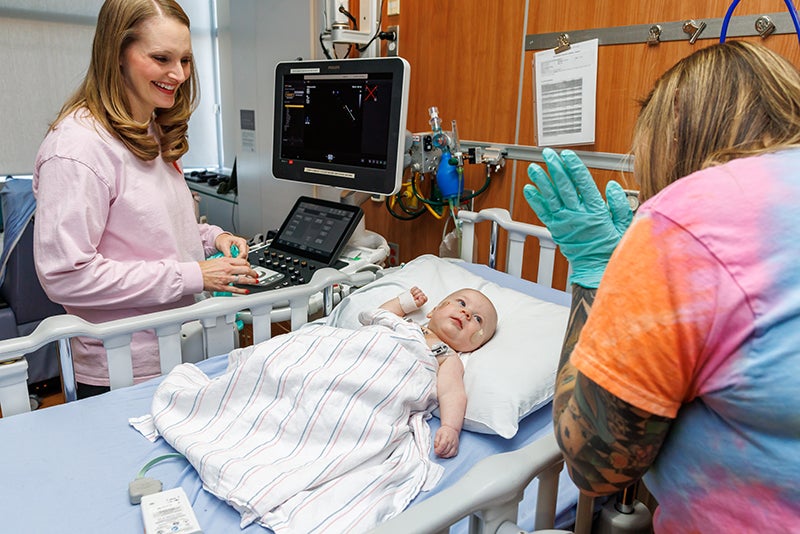
Echocardiography uses high frequency sound waves to look at the heart’s structure and function. It is the most common imaging modality that is done in children to evaluate the heart.
Types of echocardiograms:
- Transthoracic Echo (TTE): Non-invasive test done at the bedside either as an outpatient in cardiology clinic or in the hospital; our cardiologists and sonographer team perform over 18,000 each year.
- Transesophageal Echo (TEE): A probe is gently placed in the esophagus to get close-up images of the heart. This is done under sedation and is often used during procedures or surgery. We perform over 700 each year.
- Fetal echo: Our team of fetal cardiologists perform this ultrasound before your baby’s born entirely focusing on the baby’s heart.
- Specialized Echo: Includes intravascular echo (IVUS), intracardiac, and epicardial in unique situations
What to Expect During Your Child’s Echocardiogram:
The echocardiogram takes place in a calm, dim room to help your child relax. While lying down, a technician applies gel to the chest and uses a transducer to take images of the heart from different angles. The procedure is painless, but some children may have trouble staying still throughout the test.
Cardiac CT (CTA)
What is it?
- Our state-of-the-art CT scanner uses X-rays and advanced technology to create 3D images of the heart and blood vessels. It’s a relatively quick scan that is especially helpful for seeing complex heart problems in infants, vascular rings, aortic aneurysms, and unusual blood vessel structures.
- Sometimes sedation is needed to ensure the highest quality images are obtained during this test. The team caring for your child will decide if sedation is necessary.
What to Expect During Your Child’s Cardiac CTA
Your child will lie comfortably on the CT table. A special dye (contrast) will be injected into your child’s IV that helps us see the inside of the heart and blood vessels. The table will move slowly through the scanner as the camera takes detailed pictures of the heart. Our child life team is available to help your child be comfortable and entertained during the scan.
Cardiac MRI and MRA
What is it?
- Cardiac MRI uses powerful magnets and computers to create detailed pictures of your heart—without any radiation. It helps us see the heart’s structure, measure blood flow, and check how well the heart is working. Since it’s a longer test, sedation may be needed to make sure we have the highest quality images and information from this test.
What to Expect During Your Child’s Cardiac MRI
Your child will lie on a comfortable table that slides into the MRI scanner. For non-sedated scans, we provide movies and entertainment to help your child relax during the study.