Cerebral Palsy, Spastic Diplegia
When Shep Maddox was about eight months old, his parents, Richard and Kati, noticed something wasn’t quite right. He could eat, talk, and do all the things a baby should—but he couldn’t sit up on his own. That first sign led the family to United Ability’s Ability Clinic in Birmingham, where he was eventually diagnosed with mild cerebral palsy, specifically spastic diplegia, a type of cerebral palsy that primarily affects the legs.
By the age of three, Shep was referred to the Spasticity Clinic at Children’s of Alabama in Birmingham. “It’s amazing because at that one clinic you can meet with multiple doctors who evaluate your child and come up with a game plan on how to best help them,” explains Kati.
During that first visit, doctors put together a plan for Shep that started with selective dorsal rhizotomy (SDR), a surgical procedure that aims to reduce muscle tightness. He spent three weeks in the hospital post-op, followed by another week of intense physical therapy. The results were incredible. “He went from having to walk with a gait trainer before the procedure to being able to walk and run without using it anymore, which was amazing,” Kati says.
Since then, Shep has continued intensive physical therapy at Children’s. A few years later, when Shep was seven, the team recommended a major orthopedic procedure to correct the alignment of his legs. This included femoral derotation surgery on both legs and a gastroc release, hamstring release, and patellar tendon release on his weaker right side. “His legs are so straight, and they look so great,” Kati adds. “He’s doing very well.”
Now, Shep’s focus is on building strength, agility, and stamina. He’s still active in therapy at Children’s, though it’s tapered from multiple sessions a week to just once a month. “The physical therapy team is encouraging him to begin exercise classes like CrossFit to continue building strength,” Kati explains. “He also recently received new 3D-printed dynamic propulsion braces from APEX, which he loves. The gait lab at Children’s has been a huge help, letting us track every step and make sure his braces are the perfect fit.”
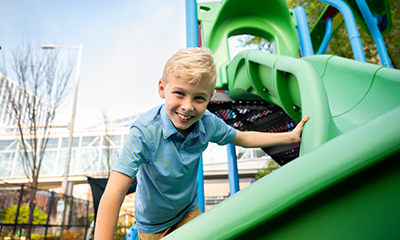
Physical therapy has been one of the most transformative parts of Shep’s journey. “The therapists at Children’s have gone above and beyond, creating customized workout plans and cheering Shep on every step of the way,” Kati says. “One of the biggest changes from these procedures is his stamina. He went from not being able to walk around by himself at Splash Adventure to moving independently—and this summer, he could play at the beach like never before.”
Through every milestone, the Children’s team has been there with guidance, encouragement, and care. Adds Kati, “We are endlessly grateful for the entire team at Children’s—they’ve been right alongside us through this entire journey.”