Olivia Ulbricht
February 26, 2026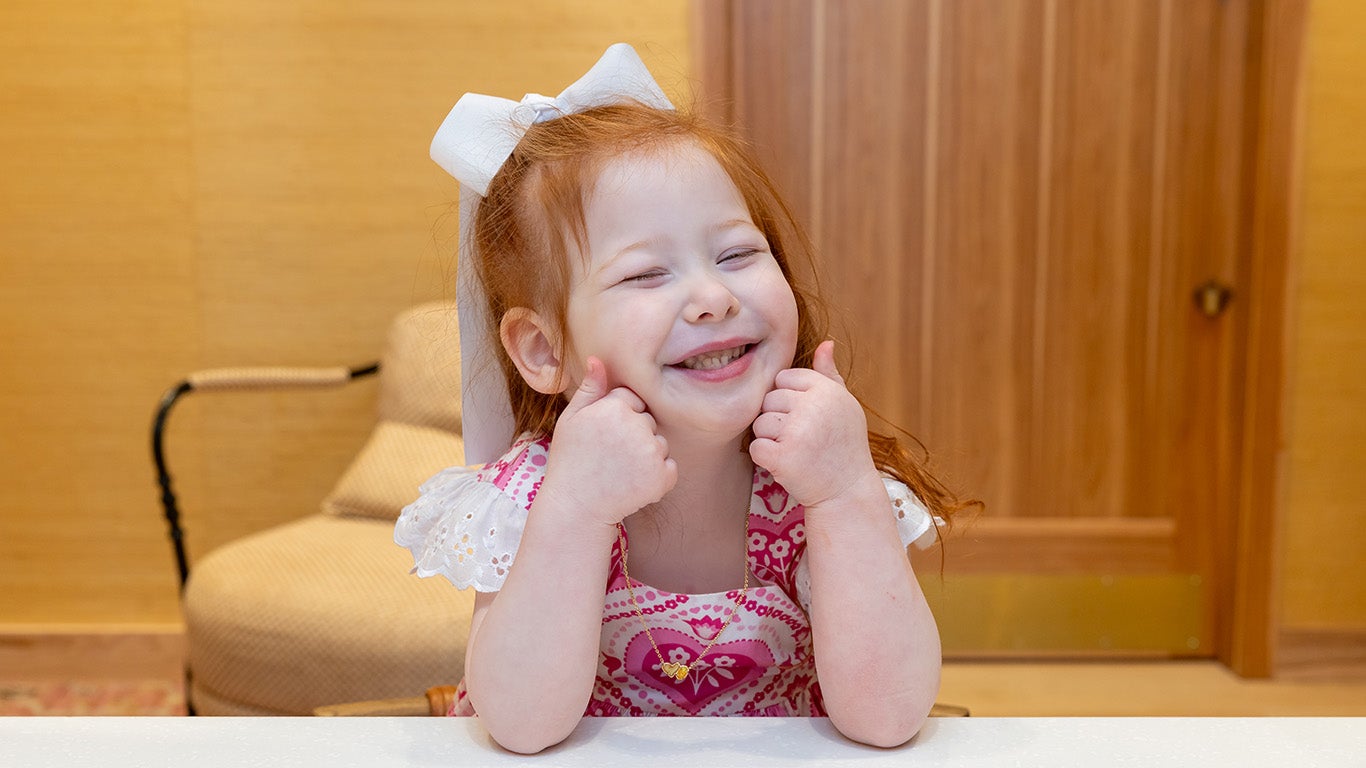
Idiopathic dilated cardiomyopathy
Olivia Ulbricht was a typical toddler. She had just turned two and was busy, bright, and growing right on schedule. But then, quietly at first, something shifted.
“Suddenly, I started feeling like something was off with her, but couldn’t pinpoint it,” her mother, Tiffany, says. “I thought something was wrong, but I was wondering if I was being overly sensitive. How much is normal versus me being overly paranoid?”
Tiffany did what so many moms do when instinct starts tapping at the back of your mind: she called the pediatrician, looking for reassurance.
“He said just bring her in and let me give her a once over and give you peace of mind,” Tiffany shares. “So I did. He took one look at her and said you’re right, something is wrong.”
She was sent directly to Children’s of Alabama, and at first, doctors thought Olivia was anemic. She was hospitalized for three days before being discharged, but when she went home, she wasn’t there long. A few days later, the Ulbrichts took her back to Children’s, and what the doctors found was far more serious than anemia: Olivia had an enlarged heart, a coarctation of her aorta, and a large blood clot in her left ventricle. The official diagnosis was idiopathic dilated cardiomyopathy.
At that point, Olivia was rushed to CVICU, where she stayed for the next few weeks while doctors worked to stabilize her. Early on, the blood clot put her on stroke alert because, if it dislodged, it could travel straight to her brain.
Thankfully, medication dissolved the clot, and slowly, she came off stroke alert. But it was clear that Olivia’s heart was dangerously weak. Doctors worked to prevent additional clots while supporting her heart function with IV medication. Once she was stable, doctors placed a stent for her coarctation, hoping it would help her recover.
“As she stabilized, we attempted a couple of IV medication weans to see if her heart could function without that extra support,” Tiffany says. “Each time, it became clear that her heart was simply too weak on its own. We knew that if she ‘failed’ those weans, we would need to move quickly to list her for transplant. The transplant process can be lengthy, and we needed time to be on our side.”
For months, the family lived at Children’s of Alabama. Over that time, the rhythms of their lives reshaped themselves around hospital hallways. They made an endcap window with tables their dining room, eating dinner there as a family at night. They celebrated birthdays and holidays inside the unit—Christmas morning, Easter, and everything in between.
“We were there a year so we celebrated all our birthdays, holidays, everything up there, and they were all part of it,” Tiffany says of the nurses and staff.
A huge part of that care came from Olivia’s child life specialist, Kassidy.
“I can’t say enough good things about her,” Tiffany says. “Not only was she there for Olivia, she was there for me and my husband.”
And while the medical care kept Olivia alive, it was the emotional care that helped her stay Olivia: She took ballet classes in the hospital, went on daily walks, and worked with occupational and physical therapy. She had a routine—including music and art therapy and even story time—keeping her active, engaged, and feeling as much as possible like a normal childhood.
“It wasn’t just medical care, it was emotional care too,” Tiffany says. “Those nurses were like aunts to her, treating her like family.”
Olivia became so familiar to the unit that the staff gave her a nickname: the mayor of the CCU. “They called her the mayor of the CCU because she’d go greet every new patient when they came in,” Tiffany says.
All the while, the family held onto hope, constantly waiting for the moment everything would change again. Then, one day, it did.
“I can still see the whole scene in my mind,” Tiffany says.
She was getting Olivia ready for a nap, when two transplant coordinators walked into the room.
“She looked at me with big smile and said she had good news and I knew instantly,” Tiffany shares.
They told Tiffany and her husband they had a match and that the transplant would happen the next day.
“I really had this sense of peace that came over me when they told us,” Tiffany says. “I was still very anxious, but not as anxious as I thought I’d be. We knew she was in excellent hands.”
Olivia’s transplant surgery went smoothly, and she was only in the ICU a few days. Before she left Children’s, Olivia rang the bell—one final moment to mark the end of a year inside the hospital. “You have to remember that was our life a solid year,” Tiffany says. “She never left or saw outside the hospital.”
The drive home was its own kind of miracle.
“I remember driving home with Olivia, and she goes, ‘Mom, there are trees. Look at all the trees!’” Tiffany says.
Today, Olivia’s back to being a kid on the go. “There’s no stopping her,” Tiffany adds. “Every day she wakes up and asks me where we are going today.”
She’s in gymnastics, takes dance, and is in a Mother’s Day Out program where she plays with friends and cousins. She has the kind of full, ordinary days that once felt impossibly far away.
“She’s a normal kid,” Tiffany says. “If you met her now, you’d never know what she has been through and that she was a heart transplant kid.”
Olivia still returns to Children’s for regular appointments, and Tiffany never forgets what made Olivia’s recovery possible—not just the transplant itself, but the months of care that got her strong enough to receive it.
“The only reason her transplant was so successful and she’s thriving right now is because of how well they took care of her,” Tiffany says. “They got her to such a strong, healthy spot.”
The family is grateful for Olivia’s entire transplant team, Kassidy, the CCU, CVICU, and every nurse who loved their daughter like family—and deeply grateful for the donor and the donor’s family, whose decision gave Olivia a future. Because now, the little girl who once lived inside a hospital is the same little girl who wakes up every morning ready to go.
And this time, she can.