Jacob Johnson
October 19, 2026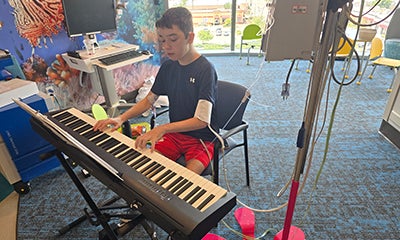
Categories: Patient Stories
Tags: Hypoplastic Left Heart Syndrome, Congenital Heart Disease, Heart Failure, Heart Transplant
Hypoplastic left heart Syndrome, heart failure, heart transplant
For Jacob Johnson, life had always included a few extra trips to Children’s of Alabama: three open-heart surgeries before he was 3 years old and regular cardiology checkups for the congenital heart defect, hypoplastic left heart syndrome, he was born with. Otherwise, his childhood looked much like any other. “If you saw him, you wouldn’t know he was any different from anyone,” his dad, Brad, said. Then, one day, everything changed. An eighth grader at the time, Jacob began experiencing chest tightness and shortness of breath.
His mother, Kim, took him to Children’s, where doctors initially thought his symptoms could be related to anxiety or a panic attack. But as the evening went on, lab work began to point to something more serious: a possible blockage. The next morning, Jacob was taken to the cardiac catheterization lab, and what followed was a frightening turn in an already uncertain situation. As doctors were inducing general anesthesia, he went into cardiac arrest. The team immediately began CPR and, after about a minute, was able to restore his heartbeat with a shock. They then continued with the procedure, discovering a blood clot blocking one of Jacob’s coronary arteries. “Doctors cleared the blockage and placed a stent, but the ordeal had taken a significant toll on his heart,” Brad explained. “They told us, after everything was over with, that the trauma that his heart had been through was going to be difficult for him.”
The hope was that, with the blockage cleared, Jacob’s heart might begin to recover. Instead, his condition continued to decline. Jacob was admitted to the Cardiovascular Intensive Care Unit (CVICU) and was closely monitored, but his heart function didn’t return as hoped. With his original congenital heart defect, the heart attack and cardiac arrest had simply been too much. Jacob was in heart failure, and soon, his lungs began to deteriorate, too.
Over the next several days, what began as one unexpected complication became a cascade of challenges. Doctors believed a bacterial infection may have contributed to the rapid decline in Jacob’s lungs, leaving his care team facing an increasingly difficult reality. “The team there said the heart is not going to recover,” Brad said. “We could potentially be 24 hours away from him dying.”
The next step was placing Jacob on extracorporeal membrane oxygenation (ECMO) and ultimately a ventricular assist device, (VAD), to help support Jacob’s failing heart. On Easter Sunday, taking time away from their families, all three of Children’s heart surgeons—Robert Dabal, M.D., Robert Sorabella, M.D., and Hampton Gray, M.D.,—came together as Jacob’s condition worsened, and placed him on a VAD.
But even then, there were no easy answers. Jacob’s lungs became so sick they could no longer adequately oxygenate his blood, creating another problem for the already complex situation and preventing him from being put on the heart transplant list right away. His team engineered a specialized oxygenator circuit into his VAD system—something that had never been done at Children’s before—allowing the system to oxygenate his blood while his lungs worked to recover. As new challenges emerged, the team continued to adapt, drawing on expertise not only within Children’s but from pediatric centers around the country.
And the setbacks kept coming. After his VAD surgery, Jacob developed a staph infection in his chest that spread into his bloodstream, leading to sepsis and severe fluid buildup throughout his body. Doctors had to reopen his chest to treat the infection. Once the infection was brought under control, the focus began to shift from simply keeping Jacob alive to helping him get stronger. That meant getting him out of bed, moving his body, and working every day to help his lungs recover. His physical, occupational, and respiratory therapists became an important part of that process. “It was many, many weeks of every day trying to get him stronger to get his lungs healed,” Brad said. “Without the work they did with him every day to try to rehab his body, he wouldn’t have made it.”
Even when he was too weak to get out of bed, Jacob kept working on his recovery in another way: playing the piano, something he’s done from a young age. His family brought a keyboard to the hospital so he could practice, giving him a way to work on his fine motor skills while doing something he loved. As he grew stronger, his music became a reflection of his progress. He could play for only a short time at first, but eventually he was able to play for 45 minutes straight. Nurses, doctors, and other patients began gathering to listen. “There were so many bad things that happened to Jacob that were outside of our control,” Brad said. “For us, his music was the ability to control one thing—a moment in time. Even if the rest of the day was ugly, Jacob could make that one moment beautiful for everyone."
So Jacob kept working. Day after day, he gradually built back his strength while his lungs slowly began to heal. The air leaks eventually closed, and his lungs began to scar over, allowing doctors to remove his chest tubes one by one. He was eventually able to come off the oxygenator as his lungs regained their ability to oxygenate his blood. “The progress was slow, and Jacob still had a cough and rattle, but by late May, we could see a difference,” Brad said. “After weeks of uncertainty, each week was beginning to bring a little more hope.”
A couple of months later, progress reached an important milestone: Jacob was officially listed for a heart transplant, and he didn’t have to wait long. Just 11 days after being listed, the family received the call they had been waiting and praying for: a donor heart had been found. The procedure was successful, though his recovery was not entirely without setbacks. A complication briefly sent him back to the CVICU, but Jacob overcame it and continued moving forward. On August 1, four months after he first entered Children’s, he was discharged to go home. Since then, he has continued recovering and getting stronger each week.
By mid-October, Jacob had made enough progress to return to school. On his first day back, the entire school came out to greet him and cheer him on, Brad said. Two days later, he played a piano performance in the school's concert hall and shared the story of his journey with his fellow students.
Throughout the four months Jacob was at Children's, he formed close bonds with the nurses, therapists and doctors caring for him—relationships that his family continues to hold onto today. For Brad, the personal connection was an important part of Jacob’s experience and recovery. “It wasn’t just people coming into work to do their day job,” he said. “They were caring for him like they would their own family.” Kim, who has worked in cardiovascular surgery for nearly two decades, says she was also struck by how willing the team was to listen, collaborate, and adjust when Jacob’s course took an unexpected turn. “It was a true team effort on everybody’s part,” she said. “The cardiologists, intensivists, surgeons, nurses—everybody was amazing at staying on top of every detail.”
Looking back on everything Jacob endured, Brad says those relationships and Jacob’s own determination became part of the reason he made it through. “He has gone through more traumas and surgeries in his life than most people do in their entire life, and he’s 14,” he said. “Jacob’s journey is a testament to what the human spirit is capable of, and he did it.”