Dewontis Groomster, Jr.
August 5, 2026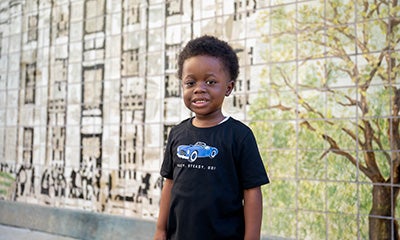
Wiskott-Aldrich syndrome
When Dewontis Groomster, Jr. was just a baby, his father knew something wasn’t right. At first, the signs were subtle. A bruise here. A change in behavior there. But as the months passed, the concerns became harder to ignore.
“He kept getting bruises and not acting like normal,” recalls his father, Dewontis Groomster, Sr. “We kept going to the hospital in Montgomery. They kept saying he was fine, but he started having discoloration, so we got sent up to Birmingham.”
What followed was a long search for answers.
At Children's of Alabama, physicians began evaluating the cause of his low platelet count. Later, when he was admitted with nephrotic syndrome—a kidney condition that causes excessive protein loss in the urine and severe swelling—the medical team expanded the diagnostic workup. Genetic testing ultimately revealed the cause of his symptoms: Wiskott-Aldrich syndrome (WAS), a rare genetic immune deficiency disorder that affects blood clotting and the body's ability to fight infections.
For nearly two years, the family bounced from doctor to doctor and diagnosis to diagnosis.
“It took until he was about a year and a half, almost 2 years old, before they got the correct diagnosis,” Dewontis says.
Because Wiskott-Aldrich syndrome is present at birth, it is often diagnosed in infancy or early childhood after symptoms begin to appear. Once Dewontis Jr.'s diagnosis was confirmed, he was referred to Dr. Parker and the pediatric blood and marrow transplant team at Children's to discuss the next step in his care.
By the time Dewontis Jr. was 3 years old, doctors determined a bone marrow transplant offered his best chance at a healthy future, but the road would be anything but easy. Before the transplant could take place, he underwent chemotherapy to wipe out his existing bone marrow and immune system. Then came the transplant itself—and an unexpected series of complications. “His body went crazy with it,” Dewontis says. “His tongue swelled so severely that he lost the ability to speak. He didn’t talk for about six months because of it.”
The swelling also made it impossible for him to eat normally. Doctors inserted a feeding tube, and there were concerns his airway could become compromised. For months, father and son lived inside the hospital, waiting for signs of progress.
In all, they spent seven months at Children’s. Yet even in the middle of treatments and uncertainty, the staff found ways to make each day feel a little more normal. They brought educational activities to his room, played games and made sure he had opportunities to simply be a kid. “They came with stuff for him to do every day,” Dewontis says. “They played with him and did educational stuff with him. They’d bring those little side-by-side toys in, and he loved it.”
Then one morning, things finally began to change. The swelling subsided, and Dewontis Jr. slowly began to recover. The milestones that once felt impossibly far away started falling into place, and conversations shifted from survival to discharge planning. After seven months in the hospital, the family finally headed home.
Today, Dewontis Jr. is thriving. His medical team continues to monitor him through checkups every six months, and his immune system continues to show encouraging signs. Recently, he was taken off all medications. The little boy who once spent months unable to speak now spends his days playing football and basketball, riding four-wheelers and chasing the next adventure. “He’s very active,” Dewontis says. “He likes to do everything.”
For a father who spent years searching for answers, those everyday moments are a reminder of just how far his son has come, and he credits that to the team at Children’s of Alabama. “The people there are phenomenal,” he says. “I consider them family now. They helped us in any way they could. They went above and beyond.”