Birmingham, Ala. (Oct. 28, 2026) — Approximately 3,400 sudden unexpected infant deaths (SUIDs) occur each year in the United States among infants younger than 1 year. Alabama continues to have one of the highest rates of sleep-related infant deaths in the nation.
Dr. Erinn Schmit, a pediatric hospitalist at Children’s of Alabama and associate professor at the University of Alabama at Birmingham (UAB), says soft bedding and babies co-sleeping with a parent or sibling are two of the most common causes of sleep-related deaths. The highest risk for sleep-related deaths in infants is between 1 and 4 months old, but Dr. Schmit recommends parents keep exercising safe sleep practices for up to 12 months.
ABCs for Safe Sleep Practices
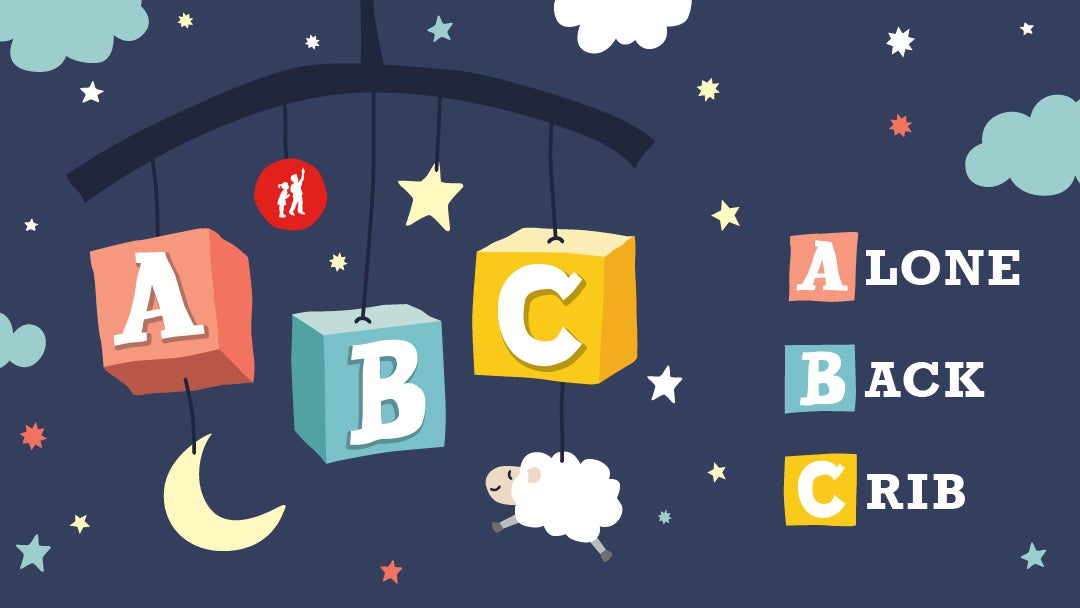
Dr. Schmit suggests using the “ABCs” of safe sleep to remember these practices. This stands for Alone, Back and Crib.
Alone: Babies should be in their own sleep environment every single time. This means using an approved consumer product safety-rated device, like a crib, Pack ‘n Play or bassinet.
Back: Babies should sleep on their backs every single time.
Crib: The crib should be empty except for a crib mattress rated for infants (a firm mattress with just a fitted sheet). There should be no loose blankets, stuffed animals, pillows or bumpers as they pose a suffocation risk.
Safe Sleep Environments
“We know that co-sleeping (sleeping with another person) greatly increases their risk for suffocation. We also see some deaths from suffocation due to soft bedding, such as pillows, blankets, sleeping on an adult mattress, or sleeping on a chair or couch. These environments are not meant for babies to sleep in,” Schmit said. “Babies should be sleeping on a firm sleep surface that doesn’t allow for any spaces where their faces can get stuck.”
For every sleep session, babies should be placed on their back until they can roll over by themselves. Swaddling is helpful for newborns who have a startle reflex that wakes them up; however, parents should swaddle their baby only until they are about 3 to 4 months old, when they begin showing signs of rolling over.
“When they’re showing signs of rolling over, you could either go cold turkey — stop swaddling them altogether—or swaddle just one arm in at a time. But we do know that swaddling while babies are trying to roll can actually increase that risk of suffocation,” adds Dr. Schmit.
Dr. Schmit also cautions against nearby cords from a baby monitor or windows with blinds near the crib. Ensure the crib or Pack n’ Play is away from the window so babies can’t pull on strings connected to the blinds. In addition, make sure baby monitors are mounted on a wall or placed on a bookcase nearby, but not directly by the edge of a crib. “Unfortunately, every year we see strangulation deaths when babies get cords or strings stuck around their necks,” Schmit said.
Sleep sacks are well known among parents with babies and are recommended. These wearable blankets have a hole for the neck and arms and either zip or snap in place. Due to the design, sleep sacks don’t have loose material that can cover a baby’s face.
Sleep sacks for younger babies swaddle with Velcro and sleep sacks for older babies have arm holes and no swaddle. Around three to four months, parents should stop swaddling and switch to a sleep sack without a swaddle.
The American Academy of Pediatrics recommends room-sharing without bed-sharing for at least the first six months, and ideally up to one year. Sharing a room can help parents hear noises and be alert to their baby’s needs which can reduce Sudden Infant Death Syndrome (SIDS) and other sleep-related deaths.
Tummy Time and Acid Reflux in Babies
Tummy time is when babies lay on their stomachs for a brief period while they are awake and supervised. The AAP recommends supervised tummy time for babies each day to help with head and neck strength, which further improves motor development. For more information on how long babies of different ages should practice tummy time, refer to this resource from KidsHealth. While babies should practice tummy time, if they fall asleep during tummy time they should be move to their backs for the rest of the sleep session. Parents should always put babies down on their back for naps and nighttime. Once they can roll themselves both front-to-back and back-to-front, it’s okay to let them roll onto their tummies to sleep.
One misconception is that placing babies on their backs may aggravate acid reflux or interfere with proper digestion. This has been scientifically disproven – when babies are lying on their tummies, the food pipe is above the windpipe.
According to the AAP and the North American Society for Pediatric Gastroenterology, Hepatology & Nutrition (NASPGHAN), sleeping on the back is safest for all babies, even those with reflux. The only situations when babies should sleep on their tummy are if they have an unrepaired surgical airway or some other serious issues—in which the doctor may recommend otherwise.
Safe Baby Devices
Parents may try to calm their fussy baby by driving around the neighborhood. Dr. Schmit said this practice is fine, but once the baby is back in the home they should be placed in the crib—not left in the car seat to continue sleeping. Dr. Schmit also urged any parent using an inclined sleeping device to stop doing so immediately.
“The AAP recommends flat surfaces, and nothing more than a 10 degree elevation for any surface a baby sleeps on. This includes inclined sleepers, rockers, swings and bouncers. Anything more than 10 degrees has an increased risk of suffocation.”
For a list of approved baby devices, Dr. Schmit recommends parents discuss options with their pediatrician or visit websites such as healthychildren.org or safetosleep.nichd.nih.gov.