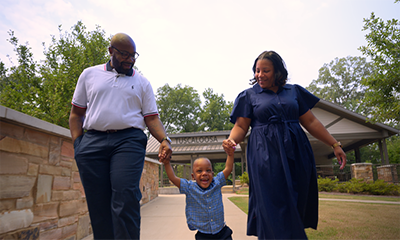
Tuscaloosa, Ala. (Sept. 30, 2026) — Two years ago, Courtney Reese thought she was going to the doctor for a regular prenatal appointment. She said before the appointment, she started experiencing pressure, but she thought it was just her baby resting on her bladder. What she did not know was that the appointment would change her family’s life and start a new chapter that included Children’s of Alabama and the neonatal intensive care unit (NICU).
“The medical journey that led my family and me to Children’s is that we had a 23-weeker,” said Courtney Reese, mother of Hunter Reese.
Hunter Reese was born on February 8. Five days later, Courtney said she received a call from her local NICU saying Hunter had a bowel perforation.
“They said he was stable so they would not fly him to Children’s, but they would transport him via ambulance,” said Courtney.
Courtney says the 45-minute drive to Children’s felt like an eternity. Once he arrived at Children’s, he was transported directly to the NICU, where doctors performed a procedure in his room. What the Reeses did not know then was that this day would mark the beginning of a six-month journey.
“I feel like we were the oldest family in the NICU,” said Courtney. “I feel like we were there forever. We saw children come, we saw children leave, and we began to draw a bond with them.”
Children’s of Alabama NICU is a level 4 intensive care unit, with 54 private rooms.
“We take care of infants that require surgical procedures. We usually take infants anywhere from birth up until 2 years of age,” said Jill Jones Smith, Director of the Neonatal Intensive Care Unit at Children’s of Alabama. “We offer special modalities such as ECMO, which is long-term heart-lung bypass for our infants. We also offer dialysis for our tiny babies.”
Smith says having a NICU like the one at Children’s in Alabama matters because it supports families whose child may need an emergency procedure. The NICU also has resources such as consultants, neuro consults, and a GI program.
“A lot of our babies do stay for a long time so they can be some of our chronic population,” said Smith. “A lot of them have defects, so they will be going home with defects. Some of them will be going home and then coming back and having surgery.”
William and Courtney Reese can personally attest to a long stay in the NICU. Their son, Hunter, experienced several medical setbacks after the bowel perforation, including being on a ventilator for a long period of time and a grade 3 brain bleed, which can happen in extremely premature babies. He also had a large patent ductus arteriosus, which is the opening between two major blood vessels near the heart that normally closes after birth. Courtney says at one point, doctors thought they would need to perform surgery to close it. But it improved over time, and surgery wasn't needed. Doctors also monitored his vision closely because he was born so prematurely and needed respiratory support for such a long time; there were concerns about retinopathy of prematurity, which can affect blood vessels in a premature baby’s eyes. Hunter had frequent eye exams while in NICU, and his vision continues to be monitored now.
“You see a lot in the NICU,” said William Reese, Hunter Reese's father. “You walk by those doors, and you have to pray. You are praying for everybody, the nurses, the families, and the doctors.”
Courtney says she often thinks back to things people take for granted.
“I remember one night, we didn’t hear about it until the next morning,” said Courtney. “Hunter had a nurse by the name of Ms. Margaret, and she told us the next day that he pulled out his breathing tube and she heard him cry. I kind of cried because I was jealous that she heard him cry, and I have never heard my baby cry.”
Courtney says that the nurse must have recognized her emotions because the next day, she pulled up YouTube and they went through different channels of baby crying so she could hear what her baby’s cry sounded like. Courtney says other moments stood out.
“I never saw my baby’s full face until maybe three months while he was in the world,” said Courtney. “I never heard his voice. I did not hold him until two months after he was born. You literally take everything, and you appreciate it a little bit more.”
William says that despite the challenging times, they connected with other families who were also NICU parents.
“I bonded with a dad, and to this day, we still keep in contact,” said William. “I remembered we all prayed together in the hallway, and they prayed for our baby to go home because their baby was about to go home.”
Smith says it can be hard on parents when their child stays in the NICU for a very long time, but they are reassured when they know their babies are in the right place and in good hands.
“They are our families, and the families feel comfortable with that because they can go home and feel assured that we are going to take care of their babies,” said Smith. “There’s nothing more enthusiastic or great than seeing a small baby or a baby that has been sick finally getting to go home with their parents.”’
Courtney and William say their son, Hunter, is now two years old and thriving. They say he is in school, and he never meets a stranger.
“We are so fortunate to be able to watch a miracle unfold in front of our eyes,” said Courtney.
Courtney and William offer this advice to parents with a child currently in the NICU.
“Patience, have hope, lean on your family and village. Trust the doctors and nurses,” said Courtney. “The boat is going to be rocky. It’s going to be a rollercoaster but be patient and believe there is light at the end of the tunnel. Your child sees your strength, feels your strength, so you have to give it your all and be your child’s advocate at the same time.”
William adds, “Trust the process, listen with your ears and not your heart. Walk away when you need to and take breaks. Your baby needs your energy.”
And they had one final thing to say.
“Thank you for taking care of our baby like he was your own,” said Courtney. “The unwavering kindness that you all showed our family, we will never be able to repay you. Thank you for working those long nights, those weekends, those long days, and holidays. You are leaving your family to care for ours. Thank you, and keep doing what you’re doing, because just like our child is a miracle, you were a miracle to us as well.”
Courtney and William wrote a letter to the NICU staff; click here to listen as she reads it.