Ivey Raper
January 27, 2026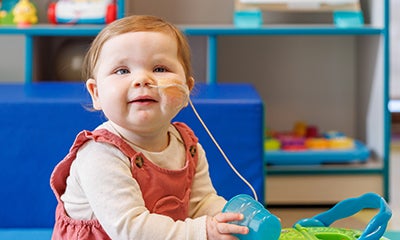
Atrioventricular (AV) canal defect and pulmonary atresia
Ivey Raper’s journey with Children’s of Alabama began long before she was even born. At her 18-week anatomy scan, Ivey’s mother, McKayla, learned that something didn’t look right. Imaging showed Ivey’s stomach positioned on the right side of her body instead of the left, prompting referral to specialists and close monitoring throughout the remainder of the pregnancy. “They didn’t have a diagnosis at that time, but they knew something was off with her heart,” McKayla shares.
Over the next few months, specialists confirmed that Ivey had a complete atrioventricular (AV) canal defect and pulmonary atresia, two rare and serious congenital heart conditions. With those findings, her care team coordinated early for McKayla to deliver at UAB, allowing Ivey to be transferred immediately after birth across the bridge that directly connects UAB Women & Infants Center to Children’s of Alabama for specialized cardiac care, ensuring no time was lost.
Initially, doctors hoped Ivey’s condition could be addressed through a series of surgeries, and a heart transplant was not expected. But when Ivey was born in October 2024, it became clear that her condition was far more severe than anticipated.
Although a stent placement had been planned shortly after birth, her care team quickly realized that Ivey was much sicker than expected and that her anatomy was more complex. The original plan was no longer an option, and decisions had to be made quickly. “At the time, doctors weren’t even sure that she could survive at all,” McKayla adds. “She was just so very sick.”
Because of the severity of her illness, Ivey required a ventricular assist device (VAD), a mechanical pump used to support heart function as a bridge to transplant. “They said the only option was a VAD, which would be a bridge to transplant,” McKayla explains. “They weren’t going to do it at Children’s at first, but they ultimately decided to do it there.”
At just 19 days old, Ivey underwent the high-risk VAD surgery at Children’s of Alabama. At the time, the outcome was uncertain. Ivey’s condition was critical, and her family was faced with difficult conversations, including the option of comfort care. “They honestly didn’t know how she would do,” McKayla says. “There was a high chance she wouldn’t survive the surgery or the recovery.” But Ivey defied expectations.
She recovered well from her VAD surgery and was soon placed on the heart transplant waiting list. After an eight-month wait—months spent in-patient at the hospital—the call finally came, and Ivey was taken to surgery for a heart transplant. The procedure, performed by Dr. Robert Sorabella, was among the most complex he has ever completed—a reflection of both Ivey’s unique anatomy and the coordinated expertise of Children’s multidisciplinary heart team. “Her surgeon told us it was the most complex transplant he’s ever done and will ever do,” McKayla says.
Just weeks after the transplant, Ivey was discharged to the nearby Ronald McDonald House before being discharged to go home for the very first time. Today, Ivey is 14 months old and continuing to grow stronger—gaining mobility, reaching milestones, and beginning to find her voice, including proudly saying “mama.”
She continues to return to Children’s for regular follow-up care, including EKGs, imaging, and lab work, but what once required multiple visits each week has now transitioned to monthly appointments. “We love her whole team at Children’s—they’ve become like family, and we’re so grateful for everything they’ve done for her,” McKayla says. “I can’t imagine where we would be without them—they’ve given Ivey a chance at life and a chance to grow every single day.”